DIMERTO - AUTHOR
Platform 319 by Dimerto - A Literary Fiction Novella About Trains, Time and Grief
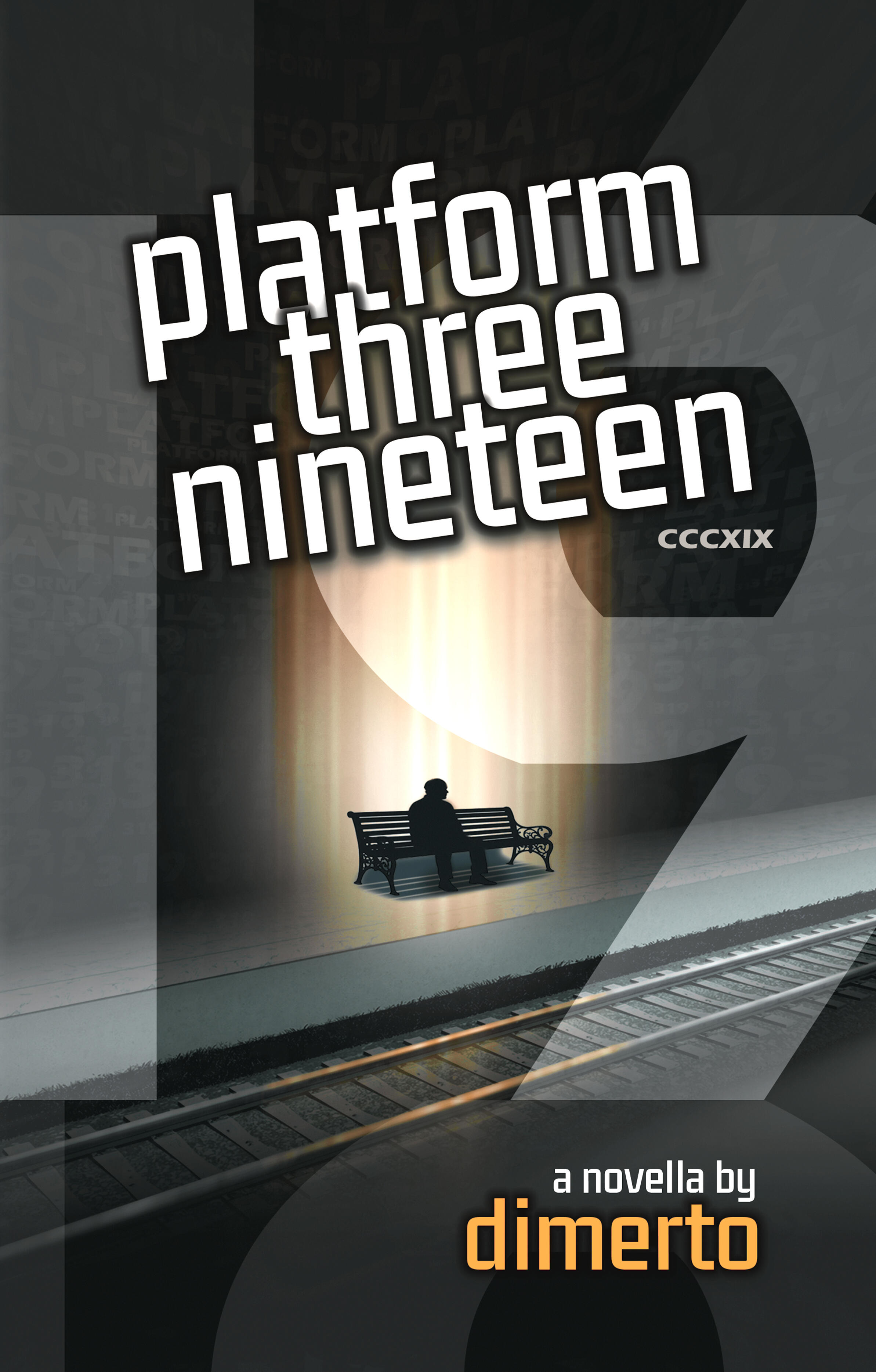
Now Available!!!
Platform Three Nineteen
Nine interconnected railroad tales and one man slowly realizing they're about him. A novella about what we leave unfinished and who's waiting for us when we're done.

PROJECT 319 - DID YOU FIND A COPY?
TELL DIMERTO THE DETAILS!
Author Bio
Dimerto
Dimerto writes literary fiction from the rails.
A working railroad conductor, Dimerto's stories explore themes of time, loss, grief, and the spaces between life and whatever comes after.
Platform 319 is a collection of interconnected train stories about reunion, regret, and the choices that define us.
Dimerto writes from locomotives and hotel Room 319s across America.
BOOKCLUB DISCUSSION TOPICS
BONUS: HOW THE STORY WAS COMPOSED
BONUS SHORT STORY: FRANKTONLAND
Newsletter
Sign Up for New Words
from Dimerto
© 2026 dimerto.com All rights reserved.
Bonus short Story
Franktonland
This tale was intended for inclusion in Platform 319, but it just didn't fit in. I didn't want Frankton to disappear entirely, so, here he is ...
FranktonlandFrankton Bosley pulled up the document on his wall screen. His doodle dog, Loons, sat beside him and drooled. Frankton talked to his pet like she could understand every word.
“Here’s Section 12, subsection C of the 2083 Transportation Infrastructure Act: ‘In exchange for railroad company investment and technical support in underground freight tube construction, the Federal Government hereby grants full ownership rights of all railroad easements and associated land rights to participating railroad companies in perpetuity.’”
He stood and tapped the wall with his stylus. “See, Loons? Right there!”
The dog simply shook her head and scattered slobber.
He highlighted the key phrase. “They meant to say ‘easement rights’ but they wrote ‘ownership rights.’ One word difference. Loons, that’s probably three billion acres.”
Frankton had been researching ownership rights for a case his firm recently assigned him—a simple dispute between two siblings over their father’s estate. One sister assumed she owned the home because she’d bought it from him before his death. Her brother claimed it was his because their father had left it to him in his will. The question was whether the father still owned the home when he passed.
Frankton was one of the few people who knew how to navigate the Springfield Congressional Library archives. He’d been deep in research about land rights when he stumbled across the railroad document.
His dog barked. “What’s wrong, mutt?”
Loons craned her neck toward the door. Break time.
Frankton stepped outside for fresh air. When he returned, the 2083 Transportation document still glowed on the screen. He stared at it, wondering. He searched the national market listings and confirmed his suspicion—railroad companies comprised four of the six largest companies currently for sale.
Walking around his small quarters, he opened his coldbox and grabbed a drink. The beverage could no longer legally be called beer, but that’s what it was. He checked his connection to the Earthdata System. His status showed secured and blank, meaning only he could access what he was viewing, and no one would know what he was researching.
The system was still in its early stages. Until last year, any electronic information had to be taken with skepticism—the artificial intelligence age had blended most data into a mixture of errors and fabrications. Only government-verified information could be trusted. Now, all data was routed through multiple verification services before being deemed authentic. Only after three independent reviews would information be stored indefinitely in the Earthdata System, which couldn’t be altered or manipulated.
He sat down, Loons beside him. “Can it be?” he mused. “Could those companies really not know?”
His dog groaned.
He grabbed his keyscreen and typed “Transportation Crisis 2080s.”
The wall screen displayed a synopsis: Freight transportation had reached a standstill. Crumbling infrastructure had left the country years behind global competitors in shipping efficiency. The European tube system was exceeding all expectations. The US Government had to intervene. The 2083 Transportation Infrastructure Act was enacted to restore America’s position in worldwide commerce.
The deal between government and railroads was completed hastily—everyone involved, including the major railroads, wanted the tube system operational quickly. Granting railroads additional rights seemed insignificant to the government.
Financially, the railroads benefited enormously, knowing their traditional market would inevitably collapse. Since they’d become worthless once freight shipments moved underground, they signed the Act without hesitation. Legal scholars warned against rushing legislation, but politicians pushed it through regardless. No one anticipated hidden consequences.
“Holy shit, Loons! Do you understand what this means?”
***
Freight rail had moved underground years ago; only a few freight trains still crossed the country. Railroads had returned to worthless passenger service, but their days were numbered as air vehicles dominated transportation.
The vast underground tube network had essentially eliminated long-haul freight from coast to coast. A sixty-foot tube container could now travel from New Angeles to York City in hours. For a while, above-ground tracks were leased for passenger service with promises of high-speed trains, but it failed—too many curves in the old routes.
Nobody realized the railroads still owned the land. They saw them as dying companies. What others dismissed as abandoned industrial waste, Frankton saw as dollar signs.
But his personal account showed three hundred and nineteen in the red. He needed help—and one million dollars.
One million was the asking price for the biggest of the major railroad companies.
Within a week, Frankton leveraged eight hundred thousand dollars, placing liens on everything imaginable. He even put a note on Loons for a hundred bucks, though she wasn’t thrilled with that arrangement.
Eight hundred thousand, wasn’t quite a million, but it would have to suffice.
***
Shipton Incorporated owned America’s largest railroad. They still moved some local freight, but most of their expansive track system was deteriorating. Daily above-ground operations hemorrhaged money with no apparent solution.
The company was making billions from underground tubes, so while railroad losses were annoying, they were merely a nuisance. No employees remained in train operations—companies had eliminated most workforce well before 2100. Only a handful of maintenance workers were employed nationwide, with minimal responsibilities but steady paychecks.
Frankton flew his air vehicle to Shipton Headquarters, a two-hour trip he used cramming railroad trivia into his head.
He entered the CEO’s office grinning.
“Hi Bob, I’m Frankton Bosley. My great-grandfather was a ‘railhead’ with this very company many years ago.”
Bob George extended his hand. “Pleasure, Mr. Bossley”—Frankton winced at the mispronunciation—”what can Shipton do for you?” Their corny but effective tagline.
Taking a deep breath, Frankton announced, “I understand the Shipton Rail Line Company is for sale.”
Adrenaline flooded Bob’s system. Finally, we have a sucker.
“Please sit, Mr. Frankton. Care for a drink?”
For an hour, they discussed trains and changing times. Bob mentioned that tubes would probably be replaced someday, claiming Shipton was already negotiating with a company called Sky Freight 7. Frankton used his plethora of rail knowledge effectively. It helped that Bob, the CEO, had no railroad experience or knowledge at all.
When finished, Frankton left as sole owner of the Shipton Rail Line Company, ensuring Shipton Inc. and its directors retained no authority over above-ground operations.
They signed away all rights for just under four hundred thousand dollars.
Shipton headquarters celebrated that night—some sucker had taken their bad investment! Maintenance workers received instant severance packages and joined the celebration from many miles away.
The kicker? Bob provided Frankton with the contact information for the four other major railroad CEOs.
By week’s end, Frankton had just over two hundred thousand dollars remaining to his name, but owned every above-ground railroad in America.
***
The following week, he assembled local legal professionals to address his “problem.” Most assumed he had buyer’s remorse for purchasing worthless companies.
Four individuals arrived at Frankton’s office. He paid each an undisclosed sum, then had them sign non-disclosure agreements before an autonotary. Which was very unusual, since NDAs hadn’t been used in years, especially with an autonotary witness.
“What’s this about?” asked Bart, a local real estate lawyer.
Straight-faced, Frankton replied, “I want to buy controlling interest in the United States of America.”
One lawyer laughed, stood, and left. “I don’t have time for this, shit.”
Three remained.
“Either that, or I want to declare myself leader of Franktonland and draft articles of incorporation for my new country.”
Bart, the local real estate lawyer, chuckled, “Thanks for the stipend, Mr. Frankton. Good luck with your psychiatric bills.” As he was leaving, he accidentally kicked over a model train on the floor. “Damn, sorry.”
Frankton shrugged and asked, “If someone owns the majority of something, don’t they have rights to the whole according to law?”
"What's your point?" asked William Shrugg impatiently, adjusting his orange and white checkered tie.
“You can’t buy the United States. Even if you could, nobody has that kind of money.”
The other man at the table was Daniel Brown, another local real estate lawyer enjoying the entertainment. He smiled as William Shrugg, a Washington College law master, stood up. Shrugg straightened his tie and addressed Frankton directly.
“Sir, before joining my colleagues at the tavern down the street, I have two questions. First, how could you afford controlling interest in the world’s sixth-largest country? You have no collateral. Second, only someone with significant land ownership can incorporate.”
Frankton smiled—this was his moment. He pressed a button, and his wall screen flickered to life. “Gentlemen, here’s a map of the thirty-one Continental United States. Agreed?” Both nodded. The map showed old Florida in grey—nobody understood how Mexico still owned it.
“The United States spans 1.8 billion acres, right?
“Yes, Mr. Bosley, where are you going with this?”
“Bear with me.” Frankton listed various countries’ land ownership: “Mexico, 480 million acres; Brazil, 2 billion; United England, 8 billion.”
“We get it. What’s the point?” Brown asked.
Frankton’s voice dropped. “What if an entity owned, say, 2 billion acres? Would they be considered a country?”
“Yes, of course.”
Frankton pressed another button. The United States map turned almost entirely purple.
Both men looked perplexed. “What is that?” Shrugg asked.
“That, my friends, is the future country of Franktonland!”
He zoomed in, revealing purple lines zigzagging throughout the country like veins.
“Gentlemen, as of yesterday, I own 2 billion undeveloped acres of the United States. I own more land than the country itself. My problem is: what do I do now?”
The two lawyers stared at the purple map.
William Shrugg's face had gone pale. "Do you understand what you've done?"
"I own a country," Frankton said, grinning.
"No," Daniel Brown said slowly. "You own a nightmare. Every derailment, every accident, every environmental disaster on that land for the past forty years - that's YOUR liability now. Retroactive. The moment you filed that incorporation, you became responsible."
Frankton's grin faded.
"The lawsuits alone..." Shrugg trailed off. "And the tax implications. Jesus. You'd need to pay property taxes on 2 billion acres."
"But the land is valuable—"
"To WHO?" Brown laughed, but it's not cruel. "You can't develop it - it's crisscrossed with easements, environmental protections, historical designations. You can't sell it - nobody wants it. That's WHY the railroads gave it away so easily. They knew."
Frankton sits down slowly. Loons whines and puts her head on his lap.
"So what do I do?"
The lawyers exchanged a glance.
"You give it back," Shrugg said gently. "You dissolve Franktonland before anyone notices it existed. You walk away."
Frankton's shoulders slumped. Two hundred thousand left. Everything else leveraged. Even Loons had a lien on her.
"Wait." Daniel Brown stared at the purple map, his eyes narrowed. "Wait, wait, wait."
"What?" Frankton asked.
"You said it's undeveloped land, right? Two billion acres of undeveloped land?"
"Mostly. Some old tracks, rotting ties, rusted equipment—"
"But no buildings? No industrial sites? Just... open land?"
"I guess so. Why?"
Brown turned to Shrugg. "The Environmental Restoration Act of 2094. Remember? The carbon sequestration subsidies?"
Shrugg's eyes widen. "Holy shit."
"What?" Frankton demanded. "What act?"
Brown was already typing on his keyscreen. "After the climate crisis of the 2080s, the government created massive incentive programs. If you own undeveloped land—especially land that connects ecosystems—you can register it for carbon credits and biodiversity preservation subsidies."
"How much are we talking?" Frankton asked.
"Depends on the land quality," Shrugg said, leaning forward now, interested. "But for 2 billion acres? Even at the lowest tier..." He paused, calculating. "Could be anywhere from two to twenty billion dollars annually."
The room went quiet.
"Annually?" Frankton whispered.
"You'd need environmental surveys," Brown said quickly. "Certifications. You'd have to prove the land isn't contaminated—well, not too contaminated. And you'd need to commit to not developing it for at least fifty years."
"I have no interest in developing it," Frankton said. "I just want my money back."
"Mr. Bosley," Shrugg said, straightening his tie again, "I think you're about to get significantly more than your money back."
***
Six months later, Frankton sat in his new office—still modest, but larger—reviewing the quarterly report. Loons lay beside him, her lien paid off months ago.
The environmental surveys had come back better than expected. Decades of abandonment had allowed native species to reclaim the railroad corridors. His land formed natural wildlife highways across the entire country. The biodiversity scores were exceptional.
The first payment from the Federal Environmental Trust had cleared his debts entirely. The second payment had made him wealthy. The projections for year three were staggering.
He kept the name "Franktonland" for his company—Franktonland Environmental Trust. No sovereignty, no articles of incorporation. Just a private land trust dedicated to conservation.
The railroad companies had been furious when they realized what they'd sold. But the contracts were ironclad. Bob George from Shipton had actually sent a formal complaint, which Frankton had framed on his wall.
"You know what, Loons?" Frankton said, scratching behind her ears. "Turns out owning a country was the wrong dream. But owning a nature preserve that happens to be the size of a country? That works just fine."
Loons wagged her tail, scattering drool across his new desk.
He didn't mind.
His keyscreen pinged. Another conservation group wanted to lease research rights on a section of his land. He smiled and began typing his response.
Outside his window, an air vehicle passed by, but Frankton barely noticed. He was too busy reading a proposal from the government about expanding the wildlife corridor program.
For one brief, shining moment, he'd almost owned a country.
Now, he owned something better: a future.
Here is a list of book club discussion topics for
Platform 319 (Spoiler Alert)
Further Reflection
I. When did you realize Thomas was reading his own story? What clues did you catch?II. Each story explores a different aspect of being “trapped” Which story resonated most with you, and why?III. “The Grandpa Tree” is significantly darker/more disturbing than other stories. Why do you think the author placed it seventh? What does Thomas need to confront there?IV. The Serpent Line shows someone who successfully finishes their work and escapes. How does this story function in Thomas’s journey?V. Thomas fears he was too absent, too focused on work—but the family’s memories contradict this. How do we reconcile our own self-judgment with how others experienced us?VI. The book suggests Platform 319 is a waiting room everyone eventually visits. Does this comfort you or disturb you? Why?VII. What treasure did Thomas pave over? What treasure have you paved over?VIII. Engine No. 8 gets restored and returns to “round and round” joyfully. What does this suggest about cycles, repetition, and choosing the same thing/person every day?IX. The “YOU TOO” ending implies the reader might be on Platform 319 now. How did this meta-fictional turn affect your reading experience?X. If you could only save one story from this book to share with someone else, which would it be and why?XI. Dimerto (the author/witness) says “Every story needs a witness.” What does this mean? Who are the witnesses in your life?XII. Thomas and Margie had 53 years together. The book suggests this was enough—that he’d “done the best a man could’ve done.” Do you agree? When is love “enough”?XIII. Would you leave this book on a bench for someone else to find? Why or why not?
XIV. How many 319 references did you catch?

This is the thought process behind the writing of
Platform 319 (Spoiler Alert)
How I wrote it.
This is the story of how I composed Platform Three Nineteen.Please, If you haven’t read the book, don’t read this. It will spoil it way too much.
If you have finished my story, thanks … enjoy.A long time ago I co-wrote a story with my best friend. I typed it up and got it copyrighted. Unfortunately, that was as far as that story went.
That story was out of sight for thirty years. A few years ago I decided to revisit it and dug into it pretty hard. It went from maybe a hundred pages to over four hundred. I breathed life back into it!
Then I got to the point where I wasn't doing the story any good by only mildly changing things here and there. It needed a rest.
That story isn't ready yet, but working on it is what led me here.
I decided to focus on something completely different — a handful of railroad themed short stories.
I was thinking a ghost story, a horror story, a fantasy …
So there I went …
The first short story I wrote was The Long Rail. It was based on a dream I had ten, maybe fifteen years ago. I typed it out on my phone in an away-from-home hotel room. Being a railroad conductor, it hit pretty hard. I know that life — the motels, the time slips, the way days blur together.
The second story was Round and Round. It started out as just a dysfunctional family getting through Christmas. Changed the point of view to the train itself and it worked much better.
The third up was Rough Track. Just meant to be a ghost story — didn't plan on it fueling the whole thing.
Sally's Dreams was going to be entirely whimsical and dreamlike, but then I added Mr. Marlon and her issues with the dark. That changed everything.
After writing it, I jotted down notes about how that story made me feel compared to the others. That became the framework for the whole book.
The guy on the bench wasn't planned — he emerged from my own reaction to my own work. That's kinda wild, I guess.
He started out as someone over-analyzing, proving points, being finicky. But then he became something else. That didn't happen quickly though — it sort of evolved.
After Sally's Dreams I stepped back and looked at what I had. I wanted the stories in chronological order but didn't have enough yet — I needed something older.
Enter: The Great Dirt Valley Train Race. It was supposed to be set in the actual Old West — with airships and hot air balloons and announcers! But it just didn't work. The bedroom floor was infinitely more intimate.
The next story was The Sunshine Bandit. I wanted a musically themed story, so I wrote a few band names down. One was KC & The Sunshine Band. That's the way, uh huh, I like it… became KC & The Sunshine Band-it. Who is KC? KC was Casey Jones. Thought it was just some good wordplay. Turned into tragedy. One of the other bands was the Steve Miller Band — more on that one later.
Treasure was meant to be the second to last story, before a piece called Franktonland — a future land grab story that's free on my website. It didn't fit the structure unfortunately, and Franktonland didn't make the final cut.
The Grandpa Tree is a collaborative effort, contracted down to its current size. I didn't originally plan to use it, but I needed a dark bottom for the whole thing to work. Looking at it now, that's probably where I lose some readers. Hopefully everybody pushes through.
The Serpent Line was entirely inspired by Rock'n Me by Steve Miller and A Horse With No Name by America. "I went from Phoenix, Arizona all the way to Tacoma…" That's literally the final line of the story.The last short story I wrote was about a man getting stuck inside an HO model railroad. I ended up using it for Thomas' wrong train journey, because he needed to experience being trapped in the wrong loop to understand what he was really waiting for.
After shuffling the order around, I finally had the idea to make Thomas the man on the bench. Truthfully I don't know exactly when that thought came to me. Will have to ask my shrink about that one.
I rewrote almost all of the in between sections and finished it off with him and Margie finally getting back together.
This is the most stunning part. I had all these stories, I had the frame of someone reading and reacting, but Thomas—the actual character, his identity, his connection to Margie — came AFTER.
I reverse-engineered his entire arc from the stories I had already written.
For the final story I wanted to bring it all together. I tried multiple ideas. One was an entire story in dialogue, daughter and grand-daughter talking about Grandma.
But I ended up with the holiday theme.
The Thanksgiving scene made the finale flow. Because I needed more than two people talking to make it work. I needed multiple voices, multiple perspectives, to show the full shape of a fifty-three-year marriage.
One person couldn't tell it. It needed the children arguing about the thermostat wars and the grandchildren asking questions and the slow reveal of the train crash that started it all.
Truthfully, I think … Well, I didn't necessarily cheat, but writing THE STORY was easy. I just had to put the puzzle pieces together in the right way.
On this little adventure, I didn't plan everything out — I discovered it. I wrote a story, saw what it was really about, then wrote another story that talks back to the first one. The structure emerged organically from the material, not the other way around.
That's why it feels so cohesive despite being assembled from pieces. Each story found its place because I guess I was listening to what they were trying to say.
I don't know if that even makes sense. Maybe I should just tell you that I started typing on my cell phone and a few thousand hours later here we are. But you deserve more. You're reading this, which means you made it all the way through!
My hat’s off to you.
Oh yeah, on the day I was scheduled to send the manuscript to my copy editor, I had the idea to bring the reader into the fold. I wrote ‘You’ and ‘You Too’ that morning.
Sent it off and then immediately thought of another layer to add. It was actually going to be a section of just Margie and her … but it totally screwed up the “I’ve got you” thing. If I would’ve had that idea earlier, it may have worked, but … perhaps a standalone Margie story would fill in the missing parts.
Hmm …
I think that being a railroader was a huge ingredient in this recipe. I spend an insane amount of time watching the world go by from a locomotive. Over twenty years, miles and miles of watching the landscape simply blur past. Sometimes in the hours that are meant for sleep, I might scribble down some notes. Those notes, if I can read them later, might spark something. Might spark a Platform Three Nineteen. Or might spark nothing at all. That is my railroad.
I LIVE the life JD lives in The Long Rail. The hotels, the time distortion, the missing your family. That story isn't research — it's an autobiography of sorts, barely disguised as fiction. And that authenticity might have bled into everything else.
Not through careful planning, but through accumulation and intuition and suddenly seeing the pattern in what I had already made.
When it was all said and done, I thought I was writing a collection of train-themed tales.
All along, I thought these were separate railroad-y stories.
I was actually writing a tale about grief, love, and completion.
They were actually all facets of one man's life, reflected back to him in pieces until he, and I, could finally see the whole.
My mom said the story was all about me … hmm.
And the fact that I'm a conductor probably had a hand in that. Ha!
That's not incidental. This book came from someone who knows trains intimately — their rhythms, their culture, their toll on family life. The Long Rail isn't fiction for me. It's a nightmare.
Oh, but then there was the book cover. I eventually found out that the real nightmare was designing the book cover. I have a graphic design background, although my skillset is probably trapped in 2003.
Anyway I went through at least 10 revisions of the book cover before ending up where the book is now.
The original idea was to have a railroad track fading into the dark distance, something that Thomas would've seen looking down the track. Every new version I thought was great until I actually compared it to similar books. Then it didn't look right at all, it didn't hint at anything about the words behind the cover.
The platform is what it's all about right?
Well, duh.
So I took the back cover that was a platform and a bench and made that the front. Tells a bit more without the whole scary train track look.
Maybe someday I'll get it right.
But of course every time I made a new rendering of the cover I had to rewrite the second paragraph of the book, the one where YOU read about the cover of YOUR book.
Then I thought I was done.
But, while I was going through my proof copy #8, I noticed the last page was numbered page 294. Way too close to 319 to not try.
Eight hours of work on it and the last words of the book (Welcome To Platform Three Nineteen) is now on page 319.
Oh, and one more thing … I purchased a pack of ten ISBN numbers, the numbers used to identify books. They are issued totally randomly, but lo and behold one of the ten had, you guessed it, 319 embedded into it. I used that ISBN number for the paperback version. 979-8-9952473-1-9 Maybe someday I’ll figure out why that number matters.
Speaking of the number 319, original date that this was published on Amazon was 3/19/26. Somehow the eBook got in early 3/18, have no idea how that happened. Working on a fix.
But even after it was published it wasn’t done. During the day of March 19th, I re-uploaded all the files at least twice to fix little typos and color issues.
Now, cross my fingers, I think I’m done.
I need a small break from this before I …
Thanks for your support.-Dimerto